Friday, May 19, 2006

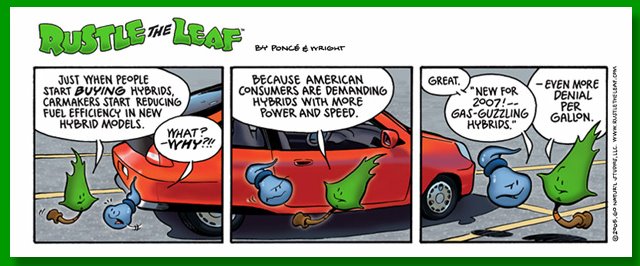
New "Trend" in Hybird Car

Source: Rustle the Leaf

With high gas prices straining our household budgets, hybrid car has been advocated (both by government, car manufactures and some scientists) as the “best” alternative of conventional petroleum-based vehicles for a long long time. Such advocacy is much more strengthened with these two years due to the striking oil price.

Originally, the rationale behind hybrid car development was to reduce gasoline consumption and reduce air emissions. Fuel efficiency, together with alternative energy source, should be the main concerns. However, new hybrids car model are very focus on power and speed, ther newer the hybrid car model, the faster and more powerful it is. It implies that more fuel/electricity are required pre journey with those newly innovations. It seems to me that there is a risk the hybrid car development is going out of the track.

The current hybrid car development trend is a good demonstration about the “effectiveness” of using technology to fix environmental problems. Technology is one of the solutions but never can be the only solution to deal with environmental crisis. In the hybrid car case, attitudes towards how and why people using car is the more underlying cause that we have to deal with. It is pointless to use an environmentally sounded technology or products in an unenvironmentally friendly way. Similar situation in the nuclear power or other renewable energy development. Shifting energy sources or finding alternative are not able to solve energy crisis if people keep using energy in consumptive and insensible way.

Sadly, the main stream environmental practice is still focus on techno-fixed solution. Although there are heaps of people and studies suggestion and urging about the essential of changing attitudes, behavior and culture, those discussion are still fighting only on paper.


Latest News on Hybrid Car: Scientists Back Plug-In Hybrids

Tuesday, May 16, 2006

A “Damn” from Space


Caption: Damning the Earth? The Keyhole Nebula NGC 3372 (Source: NASA Image Gallery)

The photo was taken in 2000 by NASA and the Hubble Heritage Team. This Nebula is about 8000 light years away.
When I saw the image first time, I found that this glowing cloud of gas, dust and stars is just like giving us their “middle finger”. Well, it is just a normal astrophysical phenomenon in the outer space. But for a raving person like me, I will say it is a damn to the Earth because those who are living on the globe is not only damaging their own planet but also dumping rubbish to the space. The world currently sends approximately 200 tons of payloads, the equivalent of two 747 freighter flights, into space annually and there is an increasing trend for such “illegal dumpling”. In US, some scientists suggested that to dump the nuclear waste into the space is the best option for nuclear waste disposal!! So, it is very reasonable why the outer space gives us their “middle finger”!!

About the Keyhole Nebula

Saturday, May 13, 2006

Ecological Footprint

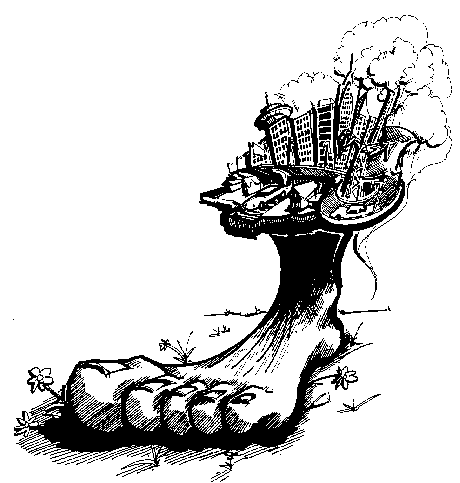
Caption:What we did and doing is making permanent mark on our planet. (Image Source: http://dieoff.org/Foot.gif)


Ecological Footprints is an environmental accounting tool to estimate the resources consumption, emissions and waster assimilation requirements of a defined human population or economy in terms of corresponding productive land use. A population’s ecological footprint is the total area of productive land or sea required to produce all the crops, meat, seafood, wood and fibre it consumes, to sustain its energy consumption with the biologically productive capacity of the land and sea available to population.

According to the WWF research in 2002, the Earth has about 11.4 billion hectares of productive land and sea space and it is about 1.9 hectares per person. Nevertheless, we consumed 2.3 hectares per person which was 20% above the Earth’s biological capacity. Moreover, due to the wealth gaps between nations, not every one can consume their own productive space. In 1999, the average for North American was about 9.6 hectares per capita, while it was 5.0 hectares per person in Europe and 1.9 for Asian and African. (China is 2.0 hectares per person in 2001)WWF predicted that the humanity’s footprint is likely to grow to about 220% of the earth’s capacity by the year 2050. It means that we need 2 more Earth to sustain our activities at that time!

Yet, there are some limitations to use ecological footprints to estimate the environmental degradation. One major deficiency of this tool is only CO2 emissions are included in land consumption calculation. Other emissions are assumed to be within the carrying capacity of receiving environment but the validity of such assumption is really doubtful.

By the way, I still think that ecological footprints is pretty useful in terms of education as it can help those who do not have science, engineering and environmental background to understand the broad picture of the land required to support their activities on a per capita basis, and of the enormous inequities between nations of the world in access to resources and pressures placed on the planet.

To calculate your own Ecological footprint: Earth Day Footprint
More about Ecological Footprint: Global Footprint Network

Friday, May 12, 2006

Quote of the Day

The word 'politics' is derived from the word 'poly', meaning 'many', and the word 'ticks', meaning 'blood sucking parasites'.

Larry Hardiman


(I tried to get more information about who is Larry Hardiman but i just failed to found more about him. What a pity!)

Wednesday, May 10, 2006

Light and Shadow


This is a photo I took in a cemetery when I went for a walk before. I was so impressed when I saw this view: shadows of different kind crosses form other graves projected on to a grave that with Mary’s statue during the sunset time. It just gave me a strong sense of peacefulness and holiness even though I am not a religious person. (I went to church for a whole year last year but eventually I reckon that those kind of spiritual stuffs do not fit in with my shoes.)

Monday, May 08, 2006

Greenwash


Image Source: Portland indymedia
, Green Left


Last week was an extraordinary busy week for me because I had to attend a short course of Environmental Auditing (EA).

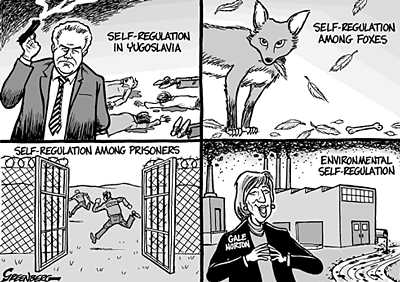
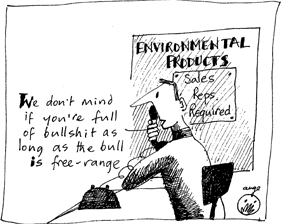
Environmental Auditing, by academic definition, is a systematic, independent and documented assessment process to evaluate the environmental performance of an organisation, a facility, a process, a service or a product against a set of pre-agreed criteria. . Performing an EA is suppose to improve environmental performance, identify risks, improve staff and public relations, ensure compliance and contribute to a defence of due diligence. However, the current EA practice seems to me that is being a tool to greenwash a company or a product. (Greenwash, by my word, is an action of giving people a false sense of eco-satisfaction and giving a positive public image to putatively environmentally unsound practices.)

The main reason for an organisation to conduct EA nowadays is to accredit with the ISO 14000 series standard to benchmark their Environmental Management Systems or “environmentally friendly” practices or products. Yet, there has some major flaw of the ISO requirement as it does not assess the real environmental performance and outcome of a company but to assess whether the company has “continual improvement” in their environmental related aspects. So, it is very possible for a company or a product accredited with ISO certification but the company is doing something harming the environment seriously. I heard a story about an environmental audit of a printing company in Australia. They did the audit in order to accredit with the ISO standards. They got the ISO certificate just by improving their printing material treatment and paper usage from “sub-standard” to “below standard. However, once the got the ISO certificate, their customers may just think that their printing activities are in “environmentally friendly” manner!! I dare to say that heaps of multinational corporations or oil companies are doing such “greenwashing” stuff. McDonald’s is a good example and their environmental management system is accredited with ISO 14001.

By the way, EA and ISO are still useful tools to get the company at least to start some improvement and awareness on their environmental performance.

Saturday, May 06, 2006

Wednesday, April 19, 2006

Ginger


It'd been a while I haven't updated my Blog. The main reasons are i'm a bit lazy and a bit busy with the new member in my apartment- Ginger, a four-months old kitten! After her arrival, we have much more funs+work with this little cat and i do really enjoy a lot althought sometimes i doubt that i am the kitten's servant instead of master!!

Friday, March 31, 2006

The Dying Out of April Fool's Day


Just wonder if anyone celebrates April Fool's Day anymore. It seems to me that the official day of practical joking appears to be as flat as a deflated cushion. In the past, people would make hoaxes during the day to bring in some funs and sense of humor in the unexcited everyday life.For example,
The Left-Handed Whopper
In 1998 Burger King published a full page advertisement in USA Today announcing the introduction of a new item to their menu: a "Left-Handed Whopper" specially designed for the 32 million left-handed Americans. According to the advertisement, the new whopper included the same ingredients as the original Whopper (lettuce, tomato, hamburger patty, etc.), but all the condiments were rotated 180 degrees for the benefit of their left-handed customers. The following day Burger King issued a follow-up release revealing that although the Left-Handed Whopper was a hoax, thousands of customers had gone into restaurants to request the new sandwich. Simultaneously, according to the press release, "many others requested their own 'right handed' version."
(Source: The Top 100 April Fools Day Hoaxes of All Time)
Well, there still has some April Fool's jokes in recent years, but most of them are circulated within Internet instead of mainstream media. One joke made by Nature.com last year that an lunar image taken by the Floating Optical Orbital Lens (F.O.O.L) revealed that the moon surface was being heavily eroded by the bacteria that Apollo lunar mission left behind!
I’d really like to have more these kinds of jokes around us. People nowadays become more serious, feeling insecure or even scare because of different sorts of instability and threats (terrorism, natural disasters, environmental degradation, more competitive and demanding workplace etc.). Depression, psychiatric or psychological problems due to pressure become more and more common, and even becomes a social problem in some big cities. So, the celebratipn of April Fool's Day may refresh our world with a bit more humours.

Interesting Links:
The Origin of April Fool's Day

The Top 100 April Fools Day Hoaxes of All Time

Monday, March 27, 2006

What is your political position?


My friend introduced a very interesting web site in his blog. It is about a test called "Political Compass" which helps us to know about our own political stand. Here is my political compass:
Economic Left/Right: -4.75
Social Libertarian/Authoritarian: -4.15

Web site: The Political Compass

Sunday, March 26, 2006

Post-Normal Science

Caption: Post-Normal Science can be located in relation to the more traditional complementary strategies, by means of a diagram . (by J. Ravetz)


These few days I am doing some reading and research on the concept of “Post-normal science” to help me diagnose the process of environmental policy making. It might be a bit sophisticated or boring for those who are not interested in the environmental stuff, but I still found it is an interesting concept to share as it can trigger us to rethink about the role and the nature of science.

Post-Normal Science is a concept to describe the methodology of scientific “facts” inquiry in contemporary conditions, especially in the environmental science and policy arena. The so-called objective “truth” or hard “scientific facts” from science research itself is no longer adequate to deal with the uncertainty, decision stakes and complexity of environmental problems. Most of environmental policy are value-driven that soft subjective human value are “hard” in various ways, for which the scientific inputs are irremediably “soft” instead. It is a new form of scientific “facts” construction and interpretation with the involvement and participation of different stakeholder & local knowledge to construct new “facts” as a basis for policy making. To put it simplier, post-normal science is:

Scientific facts+ extended facts (such as local knowledge) + human value = new perception of "scientific facts" as policy basis

After reading enormous amount of related readings, there are only two words in my mind about what happens with science in the environmental arena, i.e. “politicizing science”.
By the way, science researches are always goal-driven and value-laden. What we need to do, as a general citizen or reader or whatever, is to be more sensible with those scientific reports or articles, and think about what are the drives behind such scientific publishing, maybe we can find more interesting stories after.


Further Information: The Post-normal Time

Wednesday, March 22, 2006

Uranium Fever

Caption: Nuclear Energy is much dirter than we throught.

Australia is the world’s number two exporter of uranium after Canada despite Australia has almost half the world's known uranium supply. One reason for their “limited” uranium export is that the Howard government promised years ago (for electoral purpose) that no more new uranium mines would be allow due to environmental concern. However, the country now is under huge pressure, basically economic force, to open new uranium mines after the landmark nuclear power deal between India and the Untied States, plus the formalisation of uranium export negotiations with China since the end of last year.
Apart from the question that wheather the nuclear technology or uranium will be ended up as dreadful weapons in China or/and India, there is other question about whether the “civil nuclear energy reform” is a correct direction for long term sustainable development in developing countries.
Public opinion is gradually swinging towards accepting nuclear energy to help combat climate change but in reality, nuclear power is much dirtier, more dangerous and expensive than it apparently looks like. Although the advance in technology ensures no Chernobyl-scale disaster could happen again in theory, nuclear waste remains a major problem. Even there may be technical solutions to dealing with the nuclear waste, such toxic waste management is an ongoing, non-stop process with present technology, which means that cost and energy of dealing the waste are required for very long term. Hence, the benefits of nuclear energy to combat climate change are not clear and it seems to me that nuclear power is definitely not the answer for climate change. In addition, it consumed a lot of energy and resources to build a nuclear plant but the life-span of the plant is always too short to pay-back what it consumed. In fact, nuclear energy is a non-renewable energy and uranium is finite resource.
Sadly, the fact is uranium prices have more than tripled in the past five years to record highs, in step with higher oil prices, nuclear energy seems regard as the most common alternative (but not the most welcome) source to fossil fuels. Just wonder whether the illusion and delusion on nuclear will be clarified.

Sunday, March 12, 2006

Clean Water

Photo Source: Geotimes.org

Clean water is essential to human health, and the constant availability of clean water from tap is virtually taken for granted in where we are staying, I mean the developed urban paradise we are living. In the developing world it is the reverse. According to WHO and UNICEF, we have more than 1 billion people — about one sixth of the world's population — do not have access to safe drinking water – and it also suggest that this number could quadruple by 2025. Most of them are in rural Africa and Asia, and millions of children and leaving millions more on the brink of survival.
However, around the world our supplies of freshwater are increasingly threatened by pollution, overuse and climate change. Problems with access are most severe in the developing world but even wealthy and relatively water-rich nations, like the U.S., need to take action to ensure that their water supplies can meet looming threats.
Prescription For Survival is a science documentary that I watched tonight. It is the trigger that makes me to think about the clean water issue now. The program is a six-part documentary series and one of the topics is the clean water. It told a case of one small village in Uganda. In that remote village, the only source of fresh water for the villagers is an open pound, where is also a water source for their cattle and other animals. The only water system there is plastic water containers, children and adult. No doubt that the water is not clean and unsafe to drink. As far as I saw from TV, the water they drink is dirtier than the water I used after cleaning the floor yesterday. It makes me feel very uncomfortable when I saw them to drink! WHO and UNICEF are trying to improve the situation but they find a lot of difficulties because of lack of funding and the severe drought. Meanwhile, Australia is still using fresh, clean water for toilet flushing.
Well, I have no idea about how to fix or to improve the problem, as well as how to deal with the injustice between developed and developing country. What I think I can do is to do something from individual for first step, i.e. to use water more wisely, cautiously and carefully. It makes me feel a bit better to enjoy the fresh water while knowing somebody is suffering from not having this basic essential.

P.S. Some example water saving strategies that you don't even need to have a big change in your living habit:
- Washing dishes by hand, fill one sink or basin with soapy water. Quickly rinse under a slow-moving stream from the faucet
- Avoid flushing the toilet unnecessarily. Dispose of tissues, insects and other similar waste in the trash rather than the toilet.
- Wash vegetable and fruit in containers or sink instead of running the tap.

Useful Link
Family Water Audit
Check out to see how well you use water.
Water Saving tips A comprehensive and interactive website to investigate water saving opportunities in each area of our home.

Challenges to Clean Water Worldwide

Saturday, March 11, 2006

How fast should I run in the rain?

This is an age old question that whether we need to run or walk under the rain if we don’t have an umbrella with us. By common sense, we have to run as fast as we can to stay as dry as possible. Even there has a possibility that we are colliding with extra rains drops if we run instead of walk. We still believe that run is better than walk to keep ourselves drier.
However, some mathematicians found that there is a surprising twist to this understanding. They used mathematics formula and calculation to find out the answer and have such conclusion”

If you are a person of typical build and the rain is
coming from behind you at the speed of a gentle walking pace, you will be hit by less rain if you amble along than if you run full pelt.
- “Why Do Buses Come in Threes? The Hidden Mathematics of Everyday Life” by Rob Eastaway, Jeremy Wyndham

Well, I haven’t thought about such question seriously before. It is so easy for us to ignore and neglect something which is so common in our everyday life. But I found that I’ll have much more funs if I pay a bit more attention to something so normal to me. One of the best examples is the hidden mathematics of our daily life. For example, what is the best way to cut a cake, why the honeycombs build as hexagons, why bad things always happen in threes, etc. All of such questions are related to mathematics. So even of the people who has math phobia are actually dealing with math everyday.
I highly recommend you guys to read the book Why Do Buses Come in Threes? by Rob Eastaway, Jeremy Wyndham. It is an easy-reading and fascinatic book that gives the amusing, interesting, and practical aspects of math around us, helps you to look your daily life with one more interesting perspective.

Monday, March 06, 2006

The Bushisms

I received an email from my friend and it is some quotes of the U.S president G.W. Bush. It is really hard for me to believe that he said such thing. Could anyone be able to make such a duffer as the US President is made out to be? The first thing came up my mind is "did Bush really say all these things?"
Well, I'm not going to justify but just to share it for funs. For sure, there should be something wrong with Bush that makes people keep making jokes on him.

Here you are:

"It isn't pollution that's harming the environment. It's the impurities in our air and water that are doing it." - George W. Bush

"The vast majority of our imports come from outside the country." - George W. Bush


"If we don't succeed, we run the risk of failure." - George W. Bush

"One word sums up probably the responsibility of any Governor, and that one word is 'to be prepared'." - George W. Bush

"I have made good judgments in the past. I have made good judgments in the future." - George W. Bush

"The future will be better tomorrow." - George W. Bush

"We're going to have the best educated American people in the world." - George W. Bush

"I stand by all the misstatements that I've made." - George W. Bush

"We have a firm commitment to NATO, we are a part of NATO. We have a firmcommitment to Europe. We are a part of Europe."- George W. Bush

"Public speaking is very easy." - George W. Bush

"A low voter turnout is an indication of fewer people going to the polls." - George W. Bush

"We are ready for any unforeseen event that may or may not occur." - George W. Bush

"For NASA, space is still a high priority." - George W. Bush

"Quite frankly, teachers are the only profession that teach our children." - George W. Bush

"It's time for the human race to enter the solar system." - George W. Bush


Saturday, March 04, 2006

Quiz


I’ve done a quiz recently. It is a quiz on how well we know about what’s happening in the world. Sadly I just got half correct and I found that I have quite a lot of misconceptions about the global trend. You know, when I checked the answers, I just thought that some of them couldn’t be true, but it is! I found I got a wrong picture about the world, probably due to media misinformation or stereotyping, as well as my obsession with certain “facts”.
Go to test yourself how much you know about the things that are happening around us. It is a very good test to correct our obsession of some “facts” that we commonly know. Take a paper out and mark down your choice. I’ve put the answer in the “comment” session following this post.


1. Complete this statement: "Bicycle production has decreased over the last decade in every world region except in..."
A. Europe
B. Africa
C. Asia


2. What energy source was consumed most in 2000, after fossil fuels such as oil, coal, and natural gas?
A. Hydropower and traditional biomass
B. Nuclear
C. Solar


3. Which country—the United States, Saudi Arabia, or the former Soviet Union—produced the most oil in 1950? In 2003?
A. United States; Soviet Union
B. Soviet Union; Saudi Arabia
C. United States; Saudi Arabia


4. In 2002, United States residents emitted how much more carbon dioxide than residents of India?
A. 2 times as much
B. 17 times as much
C. 23 times as much


5. Which country leads the world in photovoltaic (solar cell) production?
A. United states
B. Japan
C. Sweden


6. Which country was home to the most Internet users in 2001?
A. Japan
B. United States
C. China


7. Which European country has on average 1.6 mobile phone subscriptions for every person?
A. Czech Republic
B. United Kingdom
C. Luxembourg


8. In 2002, the world spent $_____ on military expenditures while the UN spent $_____ on peacekeeping.
A. $735 billion; $83.7 billion
B. $943 billion; $375 billion
C. $943 billion; $2.82 billion


9. True or False? China is projected to be the most populous country in the world in 2050.
A. False
B. True


10. In 2002, did the world consume more beer, coffee, or bottled water?
A. Coffee
B. Bottled Water
C. Beer


Photo and information Source:
Worldwatch Institute

Thursday, March 02, 2006

Plasticoholic


Caption: Every year more than 100,000 whales, sea bird and sea turtle are killed by plastic bags. (Photo Source: Planet Ark )

Every minute, we consume over one million plastic bag. An estimated 500 billion to 1 trillion plastic bags are consumed worldwide each year. Billions end up as litter as only one out of five is recycled on average.

Refer back to the situation of my home town Hong Kong, it was estimated that 27 million plastic bags were disposed of each day in Hong Kong in 2001. But recent figures show that we are using 33 million plastic bags per day now. Approximately 1700 plastic bags are used per person per year, which is four to five times the consumption level per person of Australia. I believe such dramatic increase in plastic bags consumption is mainly blame to the distribution of plastic bags with newspaper purchase, which is more or less a marketing strategy started by chain convenience stores few years ago. Small news agency and kiosks have no choice but to follow in order to maintain their competitiveness. A vicious cycle formed and it further encourages our plastic bags using habit which is disaster for our environment. Too bad.

With the emerging threat of “white pollution” (that polythene jamming and blowing on the streets) and the saturation of landfill lands within 6-10 year, our government starts to act more proactively. They started the consultation of posing an environmental tax on plastic bags (and tyres as well) in a bid to help cut demand for plastic bags.

Well, I think it is a good starting although it is a bit late to response the plastic bags problem. There has some successful case of the implementation plastic bag consumption tax. Like in Ireland, their plastic consumption reduced 90% after the implementation of PlasTax. However, one important component for their success is the Irish government spent all the money they raised from the tax on environmental conservation related area. That’s one thing I’m a bit worry about Hong Kong government. I’m pretty doubt that their main initiative and objective is raising revenue, environmental focus is only an appendix. Hopefully I’m just over-worried.

Related news :

"PlasTax" - Scoop on the Plastic Bag Tax

Plastic Bags - Just say "No!"

Saturday, February 18, 2006

My Aussie Trip


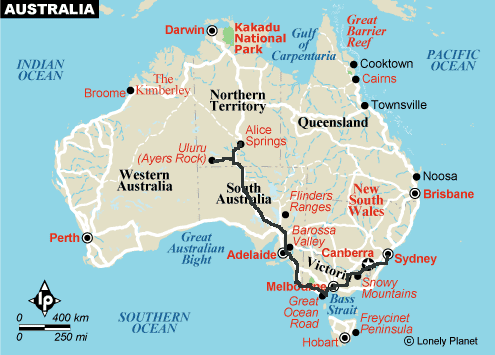
I made a "Fish-hook" tour in Oz from mid-January to early February. Here are some photos i took during the trip.
The Red Centre
Great Ocean Road
South Austrlaia

Friday, February 17, 2006

The End Of The World As We Know It

Caption: Meltwater flowing of the Greenland ice sheet, 2002. (Source: NASA Observaory)


The End Of The World As We Know, is a documentary exploring climate change I saw tonight. It did gain some noise when I broadcast in UK last year as the program emphasizes again and again that the real threat we are facing is definitely not global terrorism but global warming, which the majority are not really agree with. The presenter interviews different experts, not just environmentalists but scientists and financiers and even the Shell’s director, about their scary of climate change.
Just 30 minutes before the program, I head another bad news about the case of Greenland's glaciers. The NASA satellite just found that the Greenland’s glaciers are losing ice quicker than any scientific prediction or modeling, and the results could mean ocean levels will rise even faster than previously thought. And the glaciers may melt even more quickly in the years to come. The founding does not analysis the acceleration of the Greenland ice sheet melting and moving but most scientists agree that human activity and burning fossil fuels, is playing an important role in global warming.I received an email from a U.S. friend and he told me the majority of people in his country have no idea of how their activities use energy, or are even aware of it any level, which entitles the U.S. becomes the world biggest greenhouse gases chimney. Meanwhile the U.S. government offer different “solutions” to show their concern on the issue but it seems that the situation does not change a bit. This not only happens in the U.S. but everywhere in the world.
It is very clear that we are seeing our warning sign but we just neglect this great peril. Our modern lifestyle and “fundamental needs” are bankrupting our nature resource; threaten our future planet. It is sad that for most people the attraction of modern life resist them for a change.
Climate change is creating the hugest obstacle to humanity and human are powerless to stop GHGs forcing the climate change if we are not doing more proactively right now.

Related News: Glaciers Losing Ice Quicker

Greenland's glaciers are slip-sliding away

Sleeping - Way out for big decisions


Thinking hard about a complex decision will bamboozle our mind. Most people are only able to consider a subset of information or part of the multiple factors in conscious mind, which they may weight inappropriately and resulting in an unsatisfactory choice. Sleeping on a big decision, in contrast, the unconscious mind appears able to ponder over all the information and produce a decision that most people remain satisfied with, the scientists suggested.
How many big decisions I have ever made and how I made them? Those are the questions come up to my mind. Honestly, I can’t remember any big decision I made recently so far. Um….buying a car? Not really. I did spend some time to search but once I found the car I made the decision very soon. How about quitting my job to seek for further study opportunity? I couldn’t remember I had weighing up the pros and cons to come.
I thought I am a person who always makes snap decisions or judgments, with feeling or the sixth sense. Maybe it is a bit risky but I always remain lucky, happy and satisfy with the results produced, no matter it is wanted/expected or not. How lucky I am! Of course I am not always depend on luck, efforts sometime are required to make things nicer.

Related News: 'Sleeping on it' best for complex decisions -