 Some close-up pictures of my lovely kitty Ginger.
More Photos: Ginger, Close-up!


Caption: An Inconvenient Truth is the first climate documentary to get mainstream distribution. Former US vice President Al Gore is featured and is the narrator in the about the truths of global warming. Photo Source:Paramount Classics
"Humanity is sitting on a ticking time bomb. If the vast majority of the world's scientists are right, we have just 10 years to avert a major catastrophe that could send our entire planet into a tail-spin of epic destruction involving extreme weather, floods, droughts, epidemics and killer heat waves beyond anything we have ever experienced. If that sounds like a recipe for serious gloom and doom - think again. This documentary offers a passionate and inspirational look at former Vice President Al Gore's fervent crusade to halt global warming's deadly progress."
AN INCONVENIENT TRUTH is a climate documentary made by the former US vice president Al Gore. I’ve been waiting for this movie for long time and it showed in the Sydney Film Festival few weeks ago. Unfortunately, I missed it… too bad! I have to wait until September when it is shown in the cinemas.
Some criticisms said that the motivation of Gore make the film is to gain publicity as he is a possible presidential candidate in 2008. However, the film also make a change in the cinematic landscape in which documentaries from all sides of the political spectrum are finding audiences and affecting the political conversation. No matter what is the motivation of the documentary, it still gives a powerful lecturer on climate as it borrow a Hollywood marketing playbook to propagandize impacts of climate change as well as raining people’s environmental consciousness.
Global warming has been a passion of Gore's since he was a student a Harvard University. After losing the presidential election and leaving office five years ago, Gore pulled together a nonpartisan slide show on the effects of global warming and took it on the road, making hundreds of appearances since then at universities and colleges, and for lawmakers, environmentalists and anyone else who will listen.
View Movie Trailers Here
Official Website: An Inconvenient Truth

Days before the big kick-off, there also have been complaints from the German organisers that the marketing of this tournament has reached unacceptable levels.The amount of money paid by the World Cup sponsors rise sharply in past few years: US brewing giant Anheuser-Busch paid 40 million dollars (31 million euros) to be one of the 2006 World Cup’s 15 official sponsors, sparking outrage in Germany where all but one local beer will be banned from the stadiums in favor of Budweiser. Polls in Germany also showed that the public is growing sick of World Cup-related advertising and product tie-ins. Just wonder whether there have limits of money-making.
The side effect of money that ruins the sports not only can be found in the World Cup as it is also the core cause of the Italian match-fixing scandal. The Football Federation's prosecutor charged Juventus, AC Milan, Fiorentina and Lazio, as well as 26 individuals for sporting fraud and violating fairness and probity. Juventus almost certainly face relegation as a result of the scandal, while AC Milan may receive lighter punishment.
I am quite depressed by the news as once I was a very big fan of the Italian Serie A., especially during the age of Roberto Biaggio and the time when Del Piero started his career in Juventus. What is happening now is too bad...anyway, hopefully the scandal can give some sorts of lesson to the sports world.
More information: FIFA deny World Cup spoiled by money-making
 Photo Source: freshegg.com
Sport is the world’s most common language. The World Cup,as one of the biggest sports events, it is supposed to be a platform of building bridges across boundaries and ethnic. However, due to its enormous profit making potential, every one just tries to to make big bucks from the global frenzy and distorts the real spirit of sports, I think.
In some cities and countries, the broadcasting right is snatched by paid TV and high prices are set which avoid some lower income groups and poor people to enjoy all the 64 matches. Although the first and the last few matches are broadcasted for free everywhere, watching the process of how the teams going to the final is definitely the heart of World Cup, but such right is being deprived from some poorer people. Sports is no longer being a bridge across different people, but a potential tool to deepen the problem of social injustic as some poorer social groups are being excluded in this universal event when money is involved. What is underlying the “sports spirit” nowaday is more likely refer to the partnership between football, the economy and television which need to find a way to benefit all sides. Sports now is a bit over commericalised and capitalised. So sad to reckon this reality.
 Photo Source: The Globalist
 China is a remarkable growth story. But it is also fast becoming an ecological wasteland, home to world-class smog, acid rain, polluted rivers and lakes, and deforestation. Environmental problems play a role in the death of some 300,000 Chinese people each year, according to World Bank estimates.”
- Brian Bremner, "Business Online"
It is quite true that with the China’s “Dragonomics”, it is unrealistic to expect China
The Chinese Government also suggested heaps of schemes to deal with different environmental problem, such as Green GDP etc. But many skeptics wonder whether all these are just done for greening the Beijing Olympics 2008 and the country will lose interest after the Game. Although I am also quit suspicious about the environmental program for the Beijing Olympics is some sorts of greenwashing, I am still optimistic that the Chinese Government does learn some lesson from the Western mordernisation. So, it is too early to say whether they will lose interest and will do badly in environmental protection after the Olympics. Let’s see.
More information:
The Dirty Secret of China's Economy
Green GDP — The Real Chinese Revolution?


The city was once dominated by the coal industry, however, the coal crisis in the late 1950s brought about a structural change away from coal and steel. Today, Gelsenkirchen is more renowned for cleaner solar energy and has developed into a national business and research centre for solar technology. More than 21,000 of jobs in the renewable energy sector are also created throughout the transformation. Moreover, the end of coal to exploitation has also made way for a rich cultural landscape with mineshafts being replaced by theatres and cabarets.
Green power and solar energy debates have been lasted for years in Australia. However, moving to solar energy means a decentralization of electricity service and a reform of economy structure, which involves heaps of vested interests and large corporations. The myth between government-business relationship is definitely the biggest barrier for the clean energy transformation, from my point of views. That’s why the solar energy development in Australia is always stayed within the academic domain, while centralized nuclear energy plants development dominated the policy agendas in Oz.
(The next match in Gelsenkirchenis the quarter final between England/Ecuador and Portugal/Holland on 1 July. I do looking forward a good game in this Solar City!)
More about the city:
Science Park, Solar City, "Stairway to Heaven"
The history of the city of Gelsenkirchen

Caption: Two hydrogen are being tested by football fans in
Football fans in
This project is a part of a sustainability development program HyFLEET to contribute to the establishment of a safe hydrogen infrastructure for the European future. The buses will be tanked at a service station that the station is itself part of the experiment: a steam reformer will generate, on site, gaseous or liquid hydrogen meeting the majority of the fuel needed to feed the buses. Fuel cells from a Sweden-based company will be used to power and heat the tank station. Fuel hybrid vehicles are used in other "Lion's cities”, such as Hannover and
However, when adopting new hybrid vehicles, questions about in what way the energy source is clean and renewable, what energy use to produce the hydrogen fuel cell and what are the negative environmental impacts associated should also bear in mind.
More Information:
First hydrogen buses for
Hydrogen Buses for Football Fans at the FIFA World Cup in

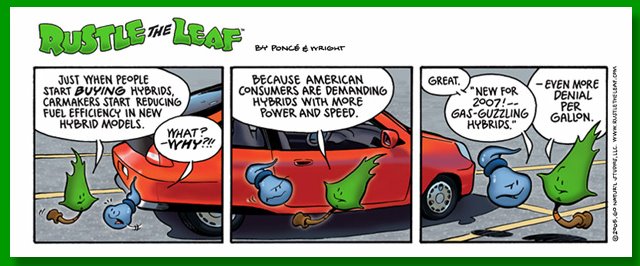 Source: Rustle the Leaf
 Originally, the rationale behind hybrid car development was to reduce gasoline consumption and reduce air emissions. Fuel efficiency, together with alternative energy source, should be the main concerns. However, new hybrids car model are very focus on power and speed, ther newer the hybrid car model, the faster and more powerful it is. It implies that more fuel/electricity are required pre journey with those newly innovations. It seems to me that there is a risk the hybrid car development is going out of the track.
The current hybrid car development trend is a good demonstration about the “effectiveness” of using technology to fix environmental problems. Technology is one of the solutions but never can be the only solution to deal with environmental crisis. In the hybrid car case, attitudes towards how and why people using car is the more underlying cause that we have to deal with. It is pointless to use an environmentally sounded technology or products in an unenvironmentally friendly way. Similar situation in the nuclear power or other renewable energy development. Shifting energy sources or finding alternative are not able to solve energy crisis if people keep using energy in consumptive and insensible way.Sadly, the main stream environmental practice is still focus on techno-fixed solution. Although there are heaps of people and studies suggestion and urging about the essential of changing attitudes, behavior and culture, those discussion are still fighting only on paper.
Latest News on Hybrid Car: Scientists Back Plug-In Hybrids

 Caption: Damning the Earth? The Keyhole Nebula NGC 3372 (Source: NASA Image Gallery)
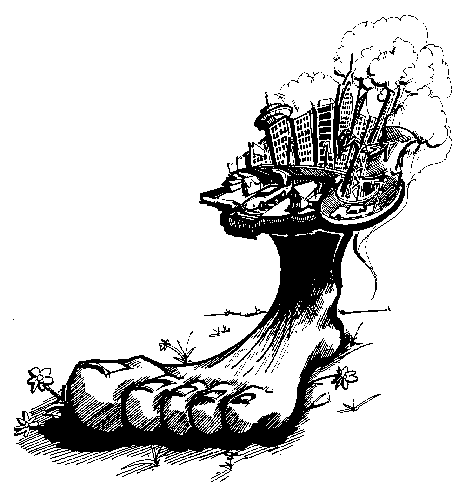 Caption:What we did and doing is making permanent mark on our planet. (Image Source: http://dieoff.org/Foot.gif)
Ecological Footprints is an environmental accounting tool to estimate the resources consumption, emissions and waster assimilation requirements of a defined human population or economy in terms of corresponding productive land use. A population’s ecological footprint is the total area of productive land or sea required to produce all the crops, meat, seafood, wood and fibre it consumes, to sustain its energy consumption with the biologically productive capacity of the land and sea available to population.
According to the WWF research in 2002, the Earth has about 11.4 billion hectares of productive land and sea space and it is about 1.9 hectares per person. Nevertheless, we consumed 2.3 hectares per person which was 20% above the Earth’s biological capacity. Moreover, due to the wealth gaps between nations, not every one can consume their own productive space. In 1999, the average for North American was about 9.6 hectares per capita, while it was 5.0 hectares per person in Europe and 1.9 for Asian and African. (China is 2.0 hectares per person in 2001)WWF predicted that the humanity’s footprint is likely to grow to about 220% of the earth’s capacity by the year 2050. It means that we need 2 more Earth to sustain our activities at that time!
Yet, there are some limitations to use ecological footprints to estimate the environmental degradation. One major deficiency of this tool is only CO2 emissions are included in land consumption calculation. Other emissions are assumed to be within the carrying capacity of receiving environment but the validity of such assumption is really doubtful.
By the way, I still think that ecological footprints is pretty useful in terms of education as it can help those who do not have science, engineering and environmental background to understand the broad picture of the land required to support their activities on a per capita basis, and of the enormous inequities between nations of the world in access to resources and pressures placed on the planet.
To calculate your own Ecological footprint: Earth Day Footprint
More about Ecological Footprint: Global Footprint Network
The word 'politics' is derived from the word 'poly', meaning 'many', and the word 'ticks', meaning 'blood sucking parasites'.
Larry Hardiman

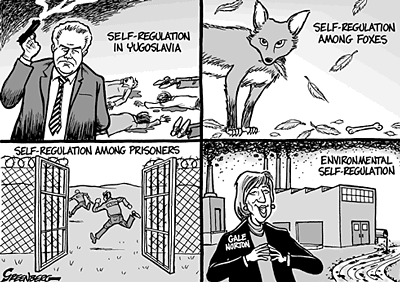
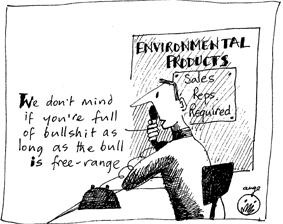
Last week was an extraordinary busy week for me because I had to attend a short course of Environmental Auditing (EA).
Environmental Auditing, by academic definition, is a systematic, independent and documented assessment process to evaluate the environmental performance of an organisation, a facility, a process, a service or a product against a set of pre-agreed criteria. . Performing an EA is suppose to improve environmental performance, identify risks, improve staff and public relations, ensure compliance and contribute to a defence of due diligence. However, the current EA practice seems to me that is being a tool to greenwash a company or a product. (Greenwash, by my word, is an action of giving people a false sense of eco-satisfaction and giving a positive public image to putatively environmentally unsound practices.)
The main reason for an organisation to conduct EA nowadays is to accredit with the ISO 14000 series standard to benchmark their Environmental Management Systems or “environmentally friendly” practices or products. Yet, there has some major flaw of the ISO requirement as it does not assess the real environmental performance and outcome of a company but to assess whether the company has “continual improvement” in their environmental related aspects. So, it is very possible for a company or a product accredited with ISO certification but the company is doing something harming the environment seriously. I heard a story about an environmental audit of a printing company in Australia. They did the audit in order to accredit with the ISO standards. They got the ISO certificate just by improving their printing material treatment and paper usage from “sub-standard” to “below standard. However, once the got the ISO certificate, their customers may just think that their printing activities are in “environmentally friendly” manner!! I dare to say that heaps of multinational corporations or oil companies are doing such “greenwashing” stuff. McDonald’s is a good example and their environmental management system is accredited with ISO 14001.
By the way, EA and ISO are still useful tools to get the company at least to start some improvement and awareness on their environmental performance.



The Left-Handed WhopperWell, there still has some April Fool's jokes in recent years, but most of them are circulated within Internet instead of mainstream media. One joke made by Nature.com last year that an lunar image taken by the Floating Optical Orbital Lens (F.O.O.L) revealed that the moon surface was being heavily eroded by the bacteria that Apollo lunar mission left behind!
In 1998 Burger King published a full page advertisement in USA Today announcing the introduction of a new item to their menu: a "Left-Handed Whopper" specially designed for the 32 million left-handed Americans. According to the advertisement, the new whopper included the same ingredients as the original Whopper (lettuce, tomato, hamburger patty, etc.), but all the condiments were rotated 180 degrees for the benefit of their left-handed customers. The following day Burger King issued a follow-up release revealing that although the Left-Handed Whopper was a hoax, thousands of customers had gone into restaurants to request the new sandwich. Simultaneously, according to the press release, "many others requested their own 'right handed' version."
(Source: The Top 100 April Fools Day Hoaxes of All Time)

 Caption: Post-Normal Science can be located in relation to the more traditional complementary strategies, by means of a diagram
Post-Normal Science is a concept to describe the methodology of scientific “facts” inquiry in contemporary conditions, especially in the environmental science and policy arena. The so-called objective “truth” or hard “scientific facts” from science research itself is no longer adequate to deal with the uncertainty, decision stakes and complexity of environmental problems. Most of environmental policy are value-driven that soft subjective human value are “hard” in various ways, for which the scientific inputs are irremediably “soft” instead. It is a new form of scientific “facts” construction and interpretation with the involvement and participation of different stakeholder & local knowledge to construct new “facts” as a basis for policy making. To put it simplier, post-normal science is:
Scientific facts+ extended facts (such as local knowledge) + human value = new perception of "scientific facts" as policy basis
By the way, science researches are always goal-driven and value-laden. What we need to do, as a general citizen or reader or whatever, is to be more sensible with those scientific reports or articles, and think about what are the drives behind such scientific publishing, maybe we can find more interesting stories after.
Further Information: The Post-normal Time


