Although Tasmania is famous for its natural environment and it is home to some of the world's tallest and oldest trees, its old growth forests are being logged at an unsustainable rate and a lot of them are being destroyed and replaced by mono-plantations. Some australia's threathen species (such as giant gum trees and Wedge-tailed Eagle) are also being threatened by these unsustainable logging practices and deforestation.

Campaigning to raise public awareness of preventing the logging in Tasmania's old growth forest is always one of the major issue among the environmental NGOs in Australia. Recently, overseas paper companies such as Mitsubishi Paper Mills decided not to accept old-growth woodchips from Tasmania. This was a positive step forward for Tasmania’s environment and encouraging outcomes for the campaigners. However, since the timber industry is a major part of the stagnant Tasmanian economy, generating sales worth more that $1 billion and employing thousands, both the state and federal governments have stepped into the breach in order to protect the state economy. Some logging company even tried to sue protestors into silence.
The battle between NGOs, government and the timber industry is still a long way to go.
More Information: Environmental Destruction in Tasmania
Tasmania Forest Campaigns- The Wilderness Society
TASMANIA FACTS
* Tasmania lies about 155 miles off the south coast of mainland Australia. It is about the same size as Ireland, and its population - 472,000 - is around the same as that of Liverpool.
* Only five per cent of Australia - the driest inhabited continent on Earth - is forested. Much of this is in Tasmania, Australia's southernmost state. Native forest covers around half of the island.
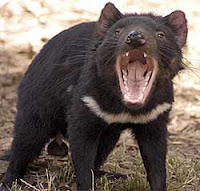
* Endemic, rare and endangered wildlife includes the Tasmanian devil, Forester Kangaroo, Fairy Penguin, Quoll and eleven bird species found nowhere else on Earth. The legendary Tasmanian Tiger, officially declared extinct in 1936, may still survive in remote parts of the ancient forests.
* Tourism in Tasmania - much of it centred on the state's wilderness - provided an
estimated 22,000 jobs in 2004; at least twice as many as the logging industry.TASMANIAN FORESTRY FACTS
* An average of 20,000 hectares of native forest are clearfelled and burned in Tasmania every year.
* 80,000 hectares of native forest have been converted to non-native plantations in the last seven years.
* Tasmania exports more woodchips than every other state in Australia combined; it is the only state that clears and woodchips native rainforest.
* An estimated 90% of wood taken from native forests on public land become woodchips, for export mainly to Japan. No more than 4% become sawn timber.
* In 2003, 14,600 hectares of native forest was clearfelled and burned. Only 6180 hectares - just over 40% - were replanted with native trees. The rest became fast-growing plantations or were converted to 'non-forest use'.
* The rate of logging in Tasmania has quadrupled over the last decade. Logging companies' profits, too, have steadily increased. Logging jobs, meanwhile, have declined. Five thousand jobs have been lost in the last 25 years, as the industry has mechanised and 'downsized.'- Source: Paulkingsnorth.net
Caption: Wineglass Bay at the East Coast. It is one of the world most photographic scene. "If I was obligated to emigrate I certainly
should prefer this place..."
- Charles Darwin, On visiting Hobart Town aboard The Beagle in 1836


I received a mysterious email from a guy/girl called “John Smith”. I know somebody called “John” and also some of my friends’ last name is “Smith”. But I don’t remember I know someone called “John Smith”. I think she/he should know me as he knows my name although he missspelt my name "Sophia" as " Sophiya". More importantly, “John Smith” should be a person know me quite well as I really really love the email he wrote to me. Here is the email:
On 11/5/06, john smith wrote:
Hi there,
A joke for a special lady.
The inmate on death row was scheduled to be put to death by firing squad the follow morning. Throughout the day, the prison guards were being very nice to him. But when they asked him if he wanted something specific for his last meal, he said he didn't want anything special. When they asked if there was something special he wanted to do, he said nothing. It went on like this all day.
Finally, when he was put before the firing squad, the guard asked if he wanted a cigarette and a blindfold.
"No," the inmate said, "just get it over with."
"Well, is there anything that I can do for you before you go?" said the guard. "You didn't even want a special last meal!"
The inmate thought. "Actually," he said, "Music is my life. One thing I would really like would be to sing my favourite song, one whole time through, with no interruptions."
The guard nodded and told him to go ahead.
The inmate started, "One billion bottles of beer on the wall..."
A friend.
He is probably be someone in Australia as it is an email from yahoo.com.au. Well, I hope I can find him out and have a drink(s) with him before I leave Oz in early Dec. ^_^

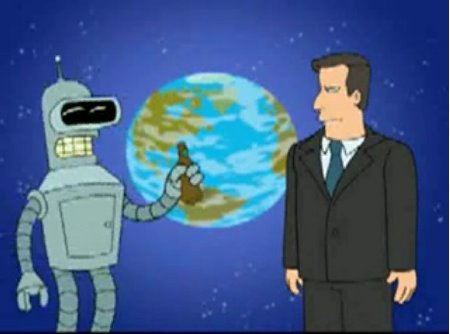
This one is from my favorite animation Futurama. It uses a funny way to explain global warming. Al Gore also replays this clip in his movie An Inconvenience Truth.
It is an conversation between Al Gore and Blender about Gore's movie. Blender is the main character of Futurama.
Source: John Fewings CartoonThere are heaps of “environmentally friendly” or “eco-friendly” products/services in the market. However, using these kinds of products/services doesn’t mean that we are doing something good to our environment. One most common example is the use of biodegradable plastic bags.
Recently, I had an interesting discussion with a man in a liquor store about plastic bag alternative. The liquor man is quite conscious about environmental issues and he is already using different alternative to reduce his business’s plastic bag consumption. He chooses to use bio-degradable plastic bags as alternative as he thought other alternative such as paper or cardboard need to chop a lot of trees and it is not good to our environment, while bio-degradable is made from starch and other degradable material which won’t harm our environmental like normal plastic bags. He wants the Australian government to substitute billions of shopping bags with biodegradable bags to solve the environmental problems created by plastic bags.
To certain extent, he is correct. But there are still lots of issues related to biodegradable bags. First of all, many of them are not 100% degradable. Than, what kind of chemicals they release when they break down in water, sun and in landfill is still uncertain, and the leftover pieces could be just as harmful as normal plastic bags. There is also an issue of the short term harmful effect to wildlife: until biodegradable products actually break down they still pose the same danger as non-biodegradable plastic bags. What more important is using biodegradable shopping bags may promote littering as people think the bags will break down in the environment no matter how they are disposed of.
Having such false sense of eco-satisfaction is very dangerous as people are not able to recognize what is being wrong and fail to figure out further improvement. The other similar example is the use of green energy. Shifting to renewable energy is good to our environment but if our energy consumption behaviors do not change, our environment won’t be benefited too much by the shift. The root cause of most of environmental problems is all about our consumptive life style.
“Doing good to environment” and “doing less harm to our environment” are fundamentally different. People should not mix these two things together or our environmental progress will remain no change or even stepping backward. Indeed, we should do both things together. We also need to be more conscious about how “green” of those "environmentally friendly" products/services are as well as being more critical about how “green” of our consumption pattern of using these kinds of products/services.

The popular legend is that mice like cheese, but this legend is false. According to a new scientific study, mice don't like cheese after all as they would reject something as strong in smell and rich in taste as cheese. They would rather have food with high sugar content such as chocolate or fruit.
I was quite surprised when I saw this news. Since I was a child, I have a strong belief, like millions of children, that the best way to catch a mouse is to entice it into a trap with a tasty chunk of cheese. I never doubt that. Now clearly the supposition of mice liking cheese is just a popular premise.
Well, I have no idea when and who started this myth. But for those who started this lie should have some sort of punishment as they'd created such a big lie!


“Cryonics (often mistakenly called "cryogenics") is the practice of cryo-preserving humans or animals that can no longer be sustained by contemporary medicine until resuscitation may be possible in the future. The process is not currently reversible, and by law can only be performed on humans after legal death in anticipation that the early stages of clinical death may be reversible in the future”
– Wikipedia Definition


“Excessive intake of alcohol, as we know, kills brain cells. But naturally, it attacks the slowest and weakest.”
– The Buffalo Theory
It is from one of my friends’ email I received recently. He tried to show me a very valid reason for drinking beer by using Darwin’s Natural Selection Theory. In the email, the Buffalo Theory explains:
"When the herd is hunted, it is the slowest and weakest ones at the back that are killed first.This natural selection is good for the herd as a whole, because the general speed and health of the whole group keeps improving by the regular culling of the weakest members.
In much the same way the human brain can only operate as fast as the slowest brain cells.Excessive intake of alcohol, as we all know, kills off brain cells, but naturally it attacks the slowest and weakest brain cells first. In this way, regular consumption of beer eliminates the weaker brain cells, constantly making the brain a faster and more efficient machine. That's why you always feel smarter after a few beers!.”
If only this were true, we'd all be genius!